relates to private voice instruction, voice classes, singing groups for elders and other affiliations

My student concerts are always free and always short. That’s how we keep the audiences coming. Oh, and audiences get to sing if they want, too.

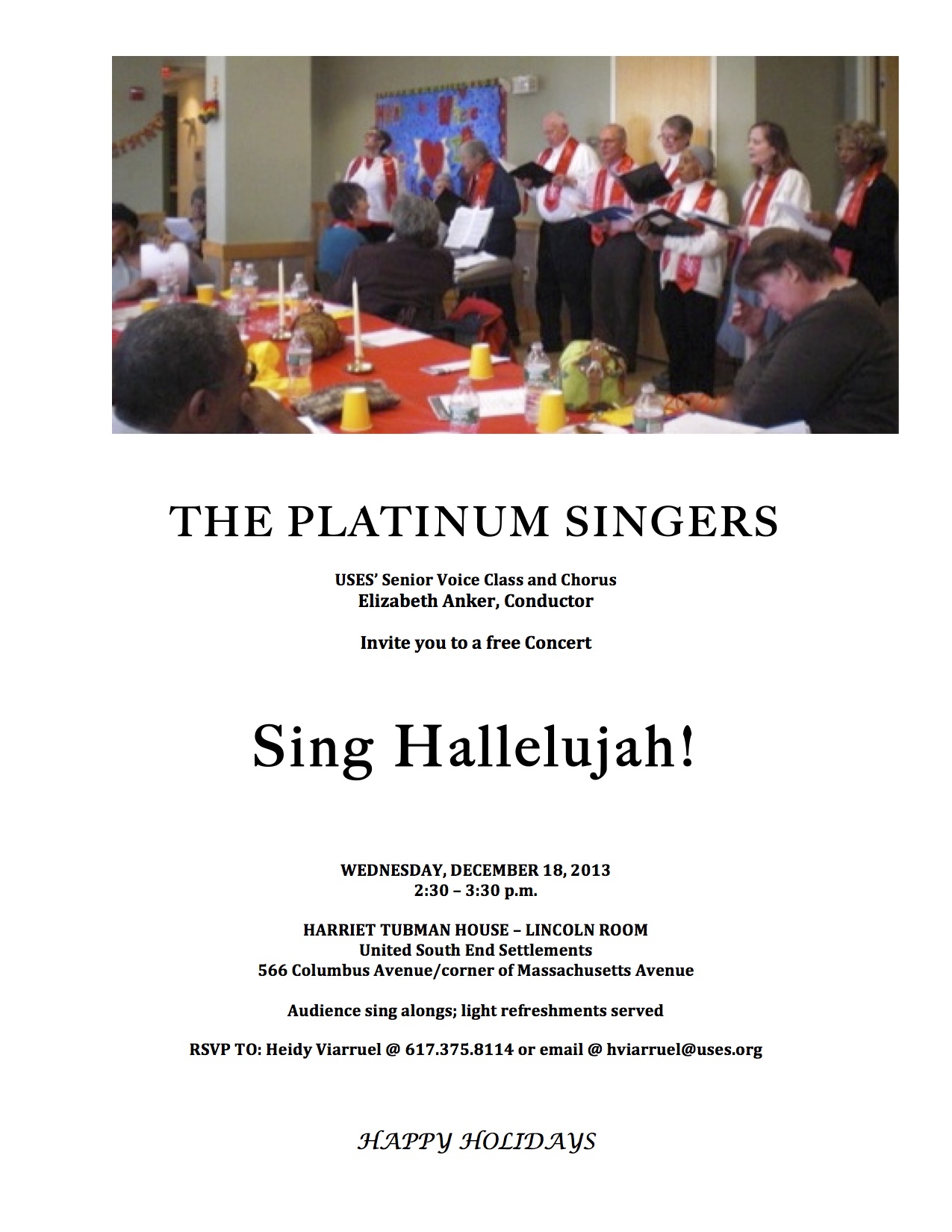
The Platinum Singers are singing their OWN songs this week, plus our own parody of YMCA*, all in a 30 minute concert at 3:00 on Wednesday April 22 at the Harriet Tubman House, corner of Columbus and Mass Ave.  Upstairs in the Lincoln Room.
*the letters of U-S-E-S (United South End Settlements, our sponsor and host for the wonderful senior programs).

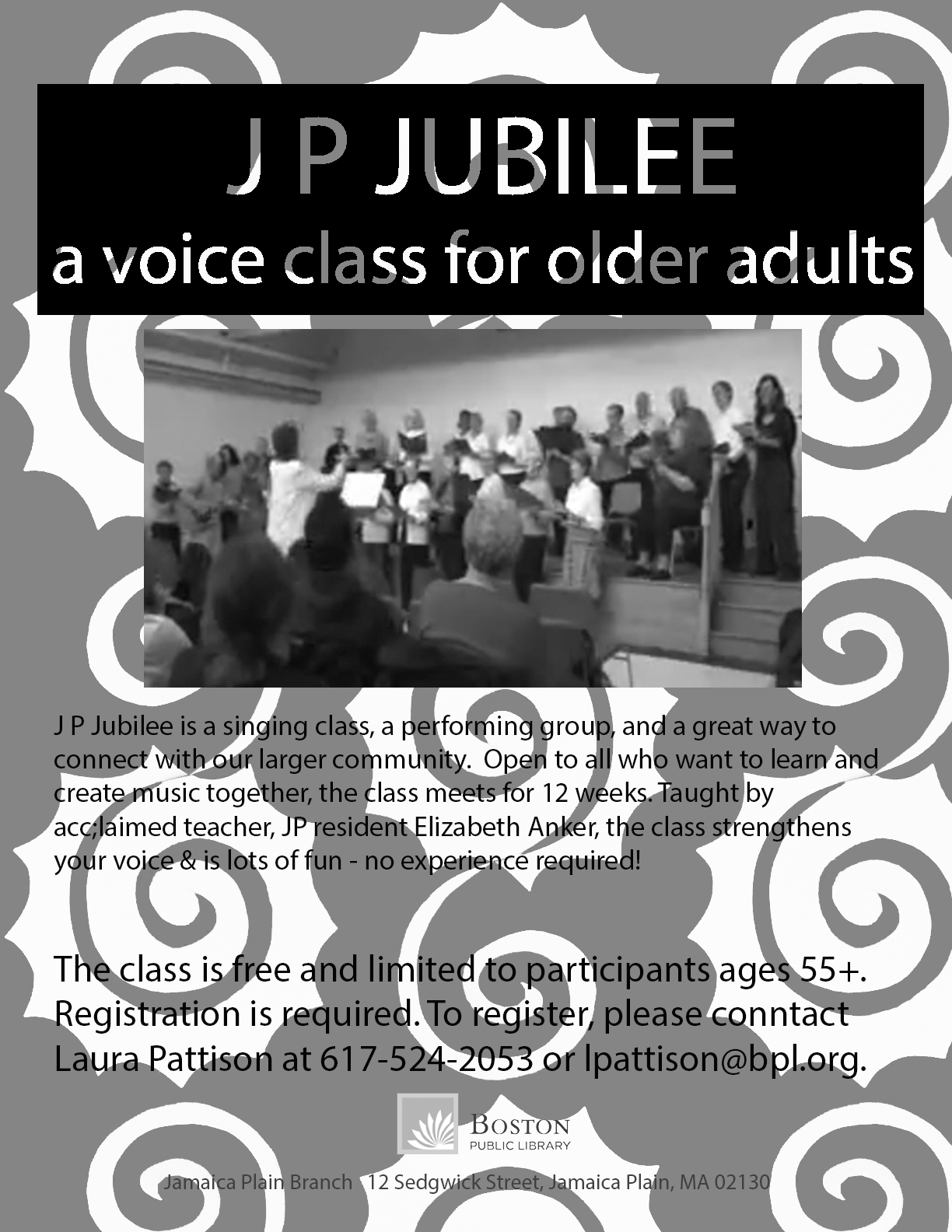
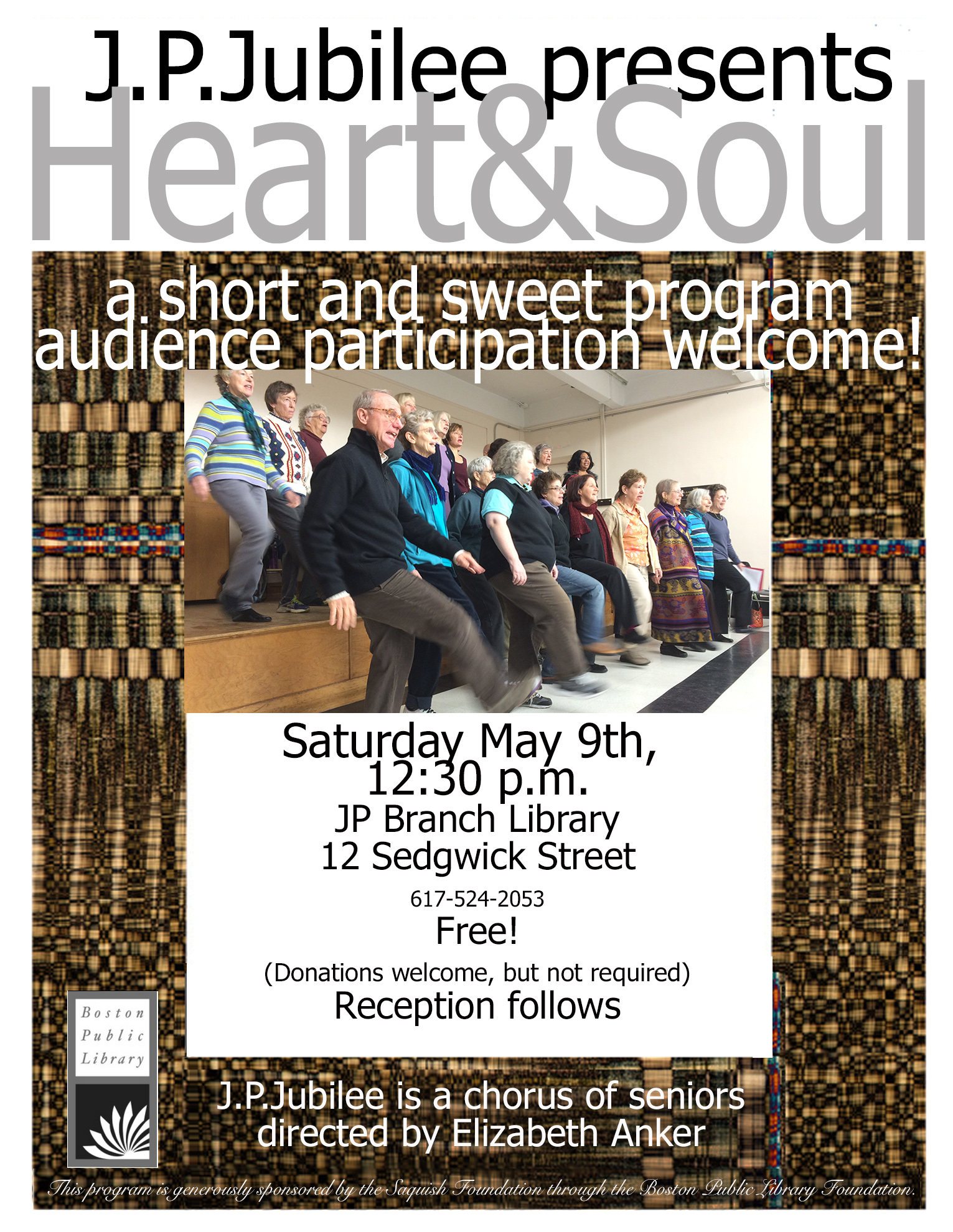
JP Jubilee does their end-of-semester concert on Saturday May 9 at 12:30pm at the Jamaica Plain branch Library.  Flyer below, by our members Lizi Brown and Estelle Disch:

A group of singers on stage, kicking their legs like Rockettes
Who says Seniors can’t kick …?

And on Wednesday, May 13 at 8:00pm, the Bach Arias Class at the New England Conservatory of Music is giving a class concert.  Just a few delicious morsels; 3 lovely singers, a violin, harpsichord and the teacher may even sing a bit with the group at the end…short, sweet and free.   Room 367 in the main building.

And, as always, I am accepting private students in Cambridge and Jamaica Plain, long or short-term…inquire within.

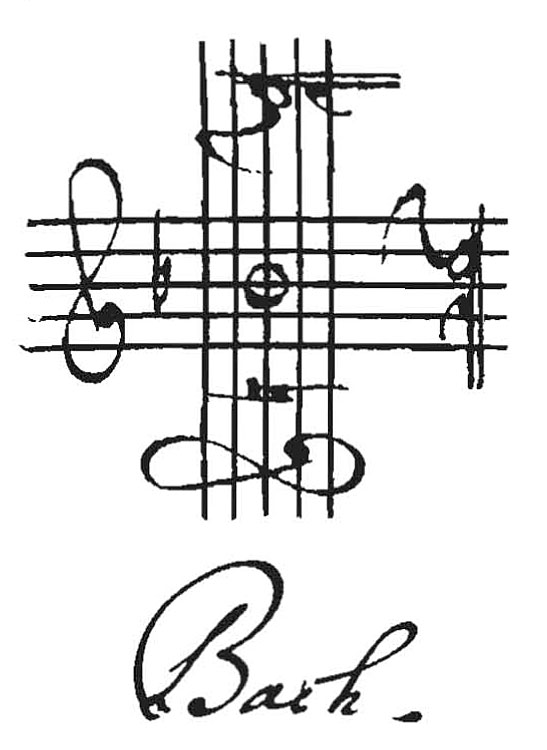
B-A-C-H

Come learn to sing and play JS Bach, improve your chamber music skills, enjoy the gorgeous arias of the cantatas and oratorios.
Class meets on Wednesday evenings 7:30-9pm. It begins January 14 and goes for 15 weeks. Even if you have to miss a few sessions, it’s a treat to get to sing and play these arias and do a performance at the end.  Open to singers, strings, winds, keyboard players.

Here’s the skinny: http://necmusic.edu/ce/voice-opera. It costs less than $45/class for 15 weeks, a non-credit class through the School of Continuing Education.

Did you know? In German, the name Bach spells out four musical notes (B —B flat, A—A natural, C—C natural, H—B natural).

“I don’t want to be known as ‘The Aphasia Guy’” said John to me at his lesson.

John came back to voice lessons after a break of several years. He said he wanted to sing to “keep the black dog” away. I figured he meant some kind of depression. He told me after a few weeks that he had recently been diagnosed with aphasia – the Greeks said it was “speechless”– and he was already having trouble remembering words.

I do my best to not furnish words for him, but instead let him describe around the word or just nod patiently and wait. But when it comes to singing lyrics of songs, he sometimes gets frustrated and shuts down. His normal lyric tenor sounds tight as he closes his mouth, tightens his jaw and sings a half-hearted “luh luh” instead of the words to the art song.

His love of music has remained, and he brings in familiar songs he knows, in German, Italian, French and English — Renaissance and 19th century — and some family songs from his childhood (He rarely gets the words wrong for those).

At first I encouraged him to sing a nice open Italian “ah” or some other open neutral sound when he forgot the words, but he really wanted to do as many lyrics as possible.

Late this summer, John wrote me an email saying he wanted to learn how to “read music better.”  I knew what he meant. He had always learned a few things wrong in each song, even before the aphasia. And once we learn a mistake, it’s hard to correct. But now the musical notation was feeling less decipherable. I wrote back that he reads music fine, but his rhythm has always needed work, so we should focus on keeping the beat, which has always given him confidence that he’s singing what’s on the page.

I don’t know why this works, incidentally, but in my years of working with singers I have witnessed again and again a great improvement in everything—words, rhythm and melody—when a student taps the beat with their hand, or even marches. John and I have done a lot of walking in lessons, when he wasn’t slapping his thigh loudly.

One day I was speaking with my friend Daniel Kempler, a professor of speech pathology whose specialty happens to be aphasia.  He told me that perhaps there is too much going on in printed music, and maybe just reading the words would be easier.  He told me that we “overlearn reading” so that it stays as a skill, even when someone might not understand the meaning of the words. I agreed. Writing the words is helpful to me, as I learn and memorize my songs. Indeed, I give an assignment to all my students before their first lesson to write down the words of their song. It’s a great way of getting in touch with the poetry without the tyranny of a notational representation of what the composer heard in his/her head.

John was unsure if this was the way he wanted to go.  After all, he is hoping to retain these musical skills. But he wrote down the words of his Purcell songs and in the lessons, we worked out a way to handle repeats.

He reads great!  We stayed with English for quite a while.

One odd thing: he keeps reading as if in a sentence, even if the melody expands on a single syllable (many notes on one word).  So we are working on a system that he can devise (and remember) that will make sense to him.  “Come, co-ome a-way-ay-ay-ay” might end up sounding like “Aye, Aye,” if one loses the context, which he can do.

In the early Fall, he told me he wanted to sing with his wife playing piano.  I consult with her teacher, a colleague at the Cambridge Music Consortium, about a good piece for the pianist, and I am delighted we all love a Schubert song, “Gute Nacht”, the first song in the long cycle, Winterreise.

John used to sing pretty well in German, but there are many long verses in “Gute Nacht.”   I suggest we look for an English translation he can sing and maybe cut some of the repeats.

John comes back the next week with his lyrics and a decent translation, not singable but at least we know what each word means.  He tries to sing it, but of course it does not scan–I tell him that singable translations rarely get the total gist of the original.

The next week he comes back with several verses for which he has made his OWN translation. And a lot of it really scans well and even has some of the alliteration and vowel sounds.  This excites me to no end.  We work on the awkward spots, and still, he sometimes just keeps reading the words.  We still get to work on the “good ni-i-ight”.

But it is coming.

I know John was a journalist. He was the Washington correspondent for a major newspaper during the Watergate era.  It is a thrill to witness the tenacity and inventiveness in his preparation for the lessons. To me, he is a Noble Member of the “Enemies List” of a certain president of the United States. And a really fun student to teach.



Sheet music to Gute Nacht

This is your chance! Daytime classes start Wednesday in the South End and Friday in Jamaica Plain. Both accessible by bus, parking is pretty darn good, and the teacher is really fun. Ostensibly for folks 55+, we do not card at the door.

The Platinum Singers meet Wednesdays 2-3:30 starting September 17 at the Harriet Tubman House, corner of Mass and Columbus Avenues in the South End. Nearly free: $15/12 classes, and no one is turned away for lack of funds.  Contact hviarruel@uses.org to register.  www.uses.org
note: no class Sept 24.

JP Jubilee begins Friday Sept 19 at 10:30 am. Flyer below

picture of singers being conducted on floral background with information about singing class

“If you saw this notated, you wouldn’t know how to begin to learn this,” said Eugene Friesen at our recent workshop in Vermont.  We all agreed.  We were moving our feet in one pattern, our mouths in another, and using rhythmic shakers in third.  Pretty shaky, overall.  I would think I had achieved some sort of groove, then would lose it.  And then gain it back by NOT thinking, but by feeling the pulse “in the lower part of your body” as master percussionist Glen Velez suggested.

two absract figures with leaves
Matisse polyrhythms

“Your Rhythm, Your Life” was the title of the workshop, but we often felt as if we were being mugged by our fears.  And yet, we each improved, improvised over the patterns and gained confidence.  I learned a lot about how I learn and how others do as well, and I had a barrel of fun improvising with the other intrepid participants, a gaggle of string players and singers.

I LOVE being a student in musical workshops.  I get to be nervous and excited, want to please the teachers, ask questions, get plenty of feedback, and not take up too much space .  It reminds me of what my students must go through in my classes.  Beginner’s mind.  Well, advanced intermediate in this case, but you get the idea.

I learn best when I’m not expecting too much or trying too hard.  I have had some of my best lessons when I was feeling under the weather–lower expectations.  When I can play at something, I discover for myself and learn the best.  When I am praised for small victories, I thrive and feel safe to take more risks.

The third teacher at this marvelous workshop is a singer, Loire.  She demonstrated, sang duets with us and played with us musically.  The last session, she said that as she looked around, we were all scowling and focusing our faces so hard.  She observed we could say “I have no idea where I am” with either a frustrated voice or a very playful voice.  We all laughed and someone said that we actually hear better with our mouths open in a smile.  Is that why it is so pleasant to have a little open mouthed yawn as we inhale to sing?  We hear better?  And I thought it just opened the physical apparatus so I could sing better.  Hmmm…

Polyrhythms.   Easier to learn  through play and body movements than thinking too much.  In through the back door.  Start with something we CAN do and build on that.  Expect fun, set reasonable goals.  Aim high as we like and be willing to allow ourselves to make some messes along the way.

blue bran with lots of arrows coming into and out of itSometimes my brain gets full. This “information age” can be quite exhausting at times. So when I attended 4 days of wonderful concerts, master classes and workshops here in Boston at the National NATS conference last week, I felt I needed a nap every day.

Actually, I felt like that in school after lunch.

But I digress. Or not. How do we absorb all this wonderful new stuff?

I find it seeps down. Sneaky deep, as my friend Cerridwen puts it.

Coming back to teaching summer lessons and classes, I found myself trying new things, on the fly, with students.  Just simple things, like closing your eyes and feeling the sound, or placing your hands gently on your cheeks to feel the gentle opening of the jaw.  Just stuff.  And I felt excited again about my students’ progress.  And they discovered new things themselves.  It wasn’t all new information, but hearing it from a different teacher (or student), gave me a new look.

A new look.  So I was looking for some French mélodies (that’s art song, the French equivalent of German Lied) and thought of an old book I was given by one of my teachers, Woody Thornton, before he moved to Europe to sing opera in the 1980’s.   Sergius Kagan’s Music for the Voice.  Still in print, and at your local library.  Chock-full of great information on songs, their range and tessitura, suitability for high or low voices, how hard the piano part is, etc.  And Mr. Kagan edited most of the International Editions I bought over the years.  So, despite databases and new books on repertoire, here was this marvelous book right next to the piano, on the shelf with dictionaries and encyclopedias.

There are 2 anthologies of French songs in my very library, edited by Mr. Kagan, with so many composers– BUT NOT Fauré and Debussy, because everybody sings a lot of those two wonderful guys.

And that’s how it goes. Hearing D’Anna Fortunato sing a short recital of Boston composers (with the Marvelous John McDonald) reminded me of how long this great legacy is.  (I’m also a booster on West Coast composers, being bi-coastal).  And hearing 2 marvelous baritone recitals of mostly American music, more great repertoire and new composers.  Hearing the scientific basis of what we intuitively know after years of using our voices and teaching others to do so, is very cool.  It seems that body-based learning is all the rage.  Who knew our style would finally become fashionable?

So, my takeaway from all this is that a nap is a good thing.  I once heard that Pavarotti said “90% of my practicing is done in bed.”  Before you get snarky and lewd, think about this: we used look at the vocabulary list before bed and be better able to give those definitions on the next day’s test.  We absorb, and the knowledge filters down, sneaky deep.


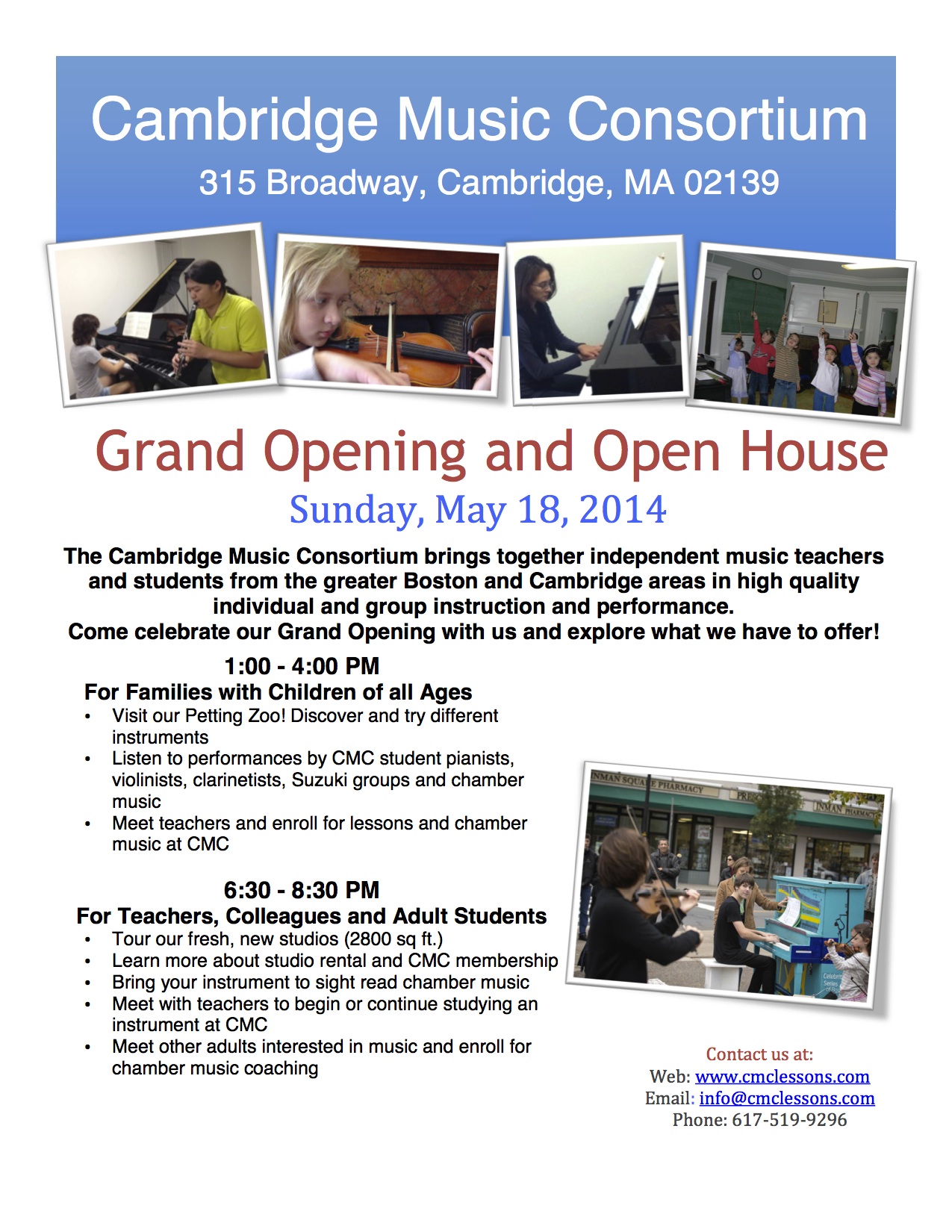
CMC Open House Flyer

I’m going to be teaching at the Cambridge Music Consortium beginning in July. I’m thrilled to be rejoining my excellent faculty colleagues from Longy in a wonderful space they have created over the past year. While I enjoyed my studio in Arlington and walking to Spy Pond on breaks,  I can now walk in beautiful neighborhoods around Broadway and do my grocery shopping at the “old Bread and Circus” on Prospect. There is an open house for the whole of CMC this coming Sunday, and I will be there in the evening shift. (There’s a “petting zoo” in the afternoon for kids. I’m not sure what one could pet on my instrument, so I’ll skip that.)  I’ll be on their website before too long, and you can contact me here if you are interested in lessons.   I will be accepting new students there on Mondays and Thursdays.


I was good in school, but bad at two things: penmanship and conduct. Got “Satisfactory” in both subjects–like a gentlewoman’s C.
I spent a lot of time in first grade in the hallway, mostly from talking. “Yes, I know the other children were talking, Liz, but we HEARD you.”

Well, I’m not sure I behave any better as an adult, but I am learning to conduct better. Conduct others, that is. Turns out, it’s a neat trick to be able to telegraph musical ideas in new ways. I’m used to singing, breathing, moving to give signals to colleagues when I’m performing. I’m accustomed to guiding the student(s) with my piano playing. Now, I am actually working with a pianist (a very good one–Megan Henderson is a singer, player and conductor herself) who will follow my gestures and take my tempi, all with a wave of a hand.

I had some great choral conductors in my life. Tom Fettke was my high school chorus teacher at Oakland High School. William F. Russell at Pomona College, Louis Magor in the San Francisco Symphony Chorus, Roger Nelson in the Port Costa Players, and Craig Smith at Emmanuel Music in Boston. All these folks LET US SING, they let us BE MUSICAL. You have no idea how many conductors try to control a group of singers and get no music made at all. Others try but are ineffective at keeping a beat or showing what they want.

The leaders who inspire me clearly LOVE their players and the music. I once sat onstage to watch Bernard Haitink conduct the Concertgebouw Orchestra in Brahms 2nd Symphony (We called it the Tweedy symphony after that because of the Dutch spelling of 2nd: Tweede). He looked at his players with such warmth and respect, and wow, did he get a sound from them.

This past weekend I heard and saw Maria Schneider and her Orchestra perform in Boston. This woman attracts the very best jazz players, folks who ordinarily wouldn’t be playing with such a big group–they are all marvelous soloists on their own. And she not only writes such beautiful arrangements, but she clearly lets them do their musical thing. Not just on their solos,  but being musical partners to her tunes all through.

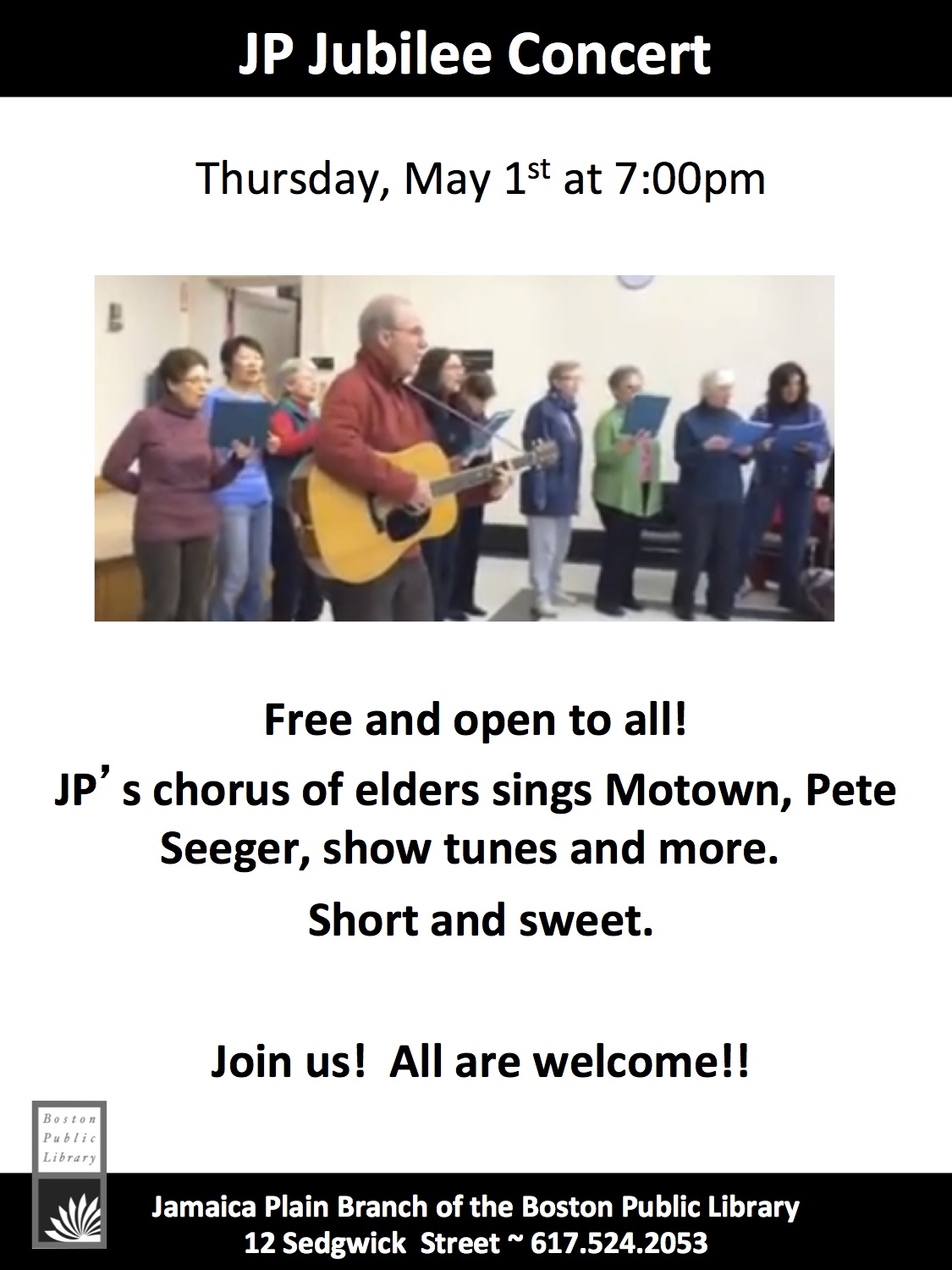
group of singers standing around a guitarist, having fun

So as I begin my new phase of conducting these voice classes of elder adults–away from the piano, just standing and waving and breathing–I am inspired by the marvelous models above. And others. So far, so good. We sang a dress rehearsal at a senior residence this morning, and I really enjoyed just being with the music and with my group. Listening, loving, not worrying about how I was doing, being in the moment.

What a gift.

JP Jubilee in concert tomorrow night, Jamaica Plain branch library, 7:00, free. Very short program.

Platinum singers begin their summer session May 7 at the Harriet Tubman House.

The chorus at the Simon Fireman Home in Randolph is making a couple of field trips in June (one to visit the Platinum Singers, their “cousins” through me, and the other to the “Mother Ship” of Hebrew Senior Life in Roslindale.)  We’re working on “Goin’ to Boston” and other tunes about Time and Place.

I hesitate to call my elder singers “cute.”  But that keeps coming to mind.  My mom used that word plenty and I’ve used it from everything to describe shoes, food, people and especially animals.   Can’t help it.  But what is NOT cute about:

  • folks who have already proven themselves as capable, competent,  distinguished and all the other adjectives that describe adult behavior AND
  • are willing to be silly and playful in order to find creative expression.

It’s not that we try to act silly in class or onstage.  It’s just that we are willing to let go of those carefully crafted personas we developed as we grew into adulthood.  We let go of having to be in charge and set an example to the kids, the bosses, the clients.

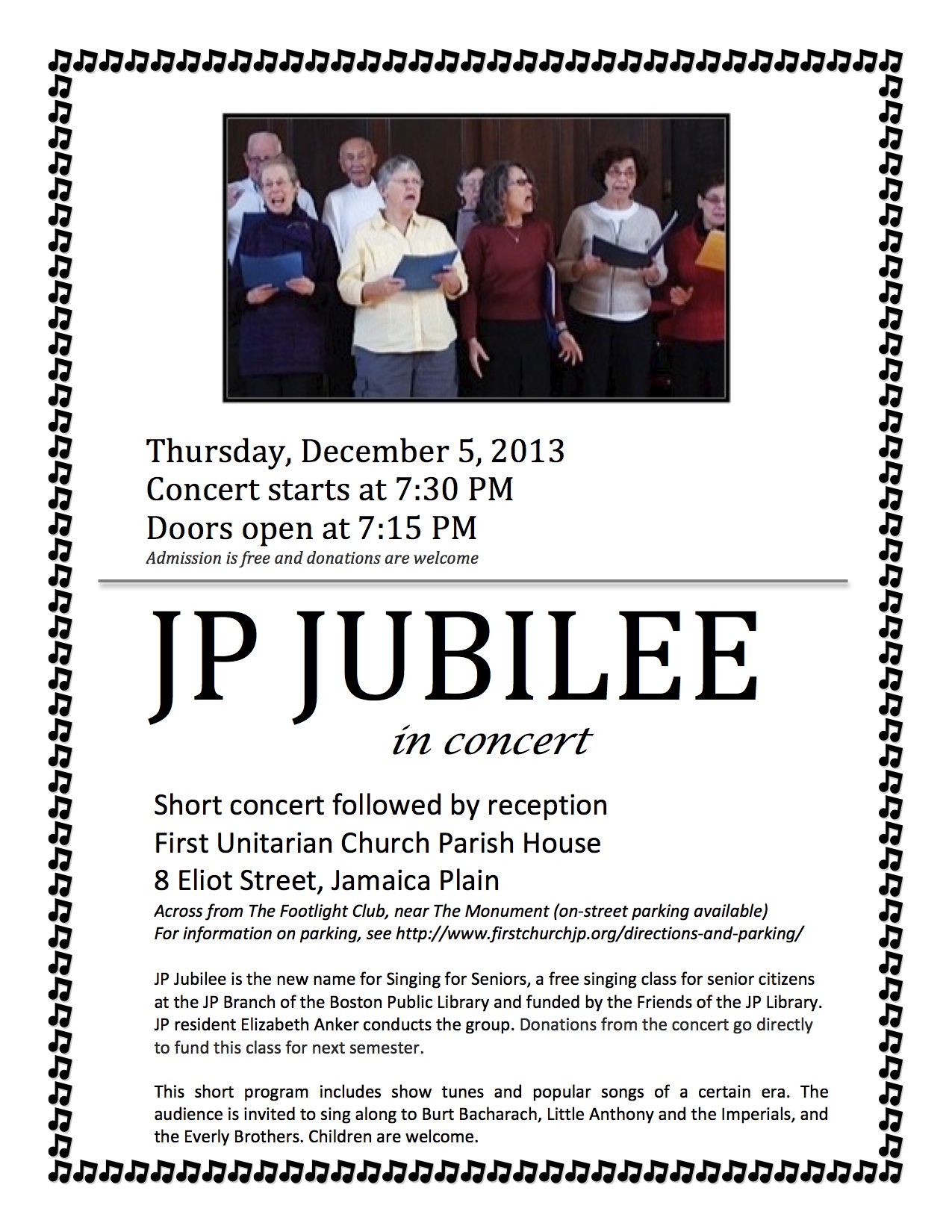
I teach all ages and learn from them all.  That’s the fun of teaching, continuing to learn.  What I notice is how LITTLE my older students complain about what they cannot do or what ails them.  They go on, move forward and keep growing.  It inspires me to be a better conductor and pianist.  So, come to one of the class concerts I’m conducting in the next few weeks.  JP Jubilee is the new name for Singing for Seniors at The Boston Public Library. Our concert will be short, free and full of fun.  Thursday December 5 at 7:30 pm in Jamaica Plain, see full info below.a group of energetic senior singers with their mouths open in song

…And The Platinum Singers are performing at the Harriet Tubman House on Wednesday, December 18 at 2:30 in the afternoon.  An in-house concert of an hour with these sweeties.  We just had a grand pre-Thanksgiving lunch with a terrific group called “Grandparents Raising Grandchildren”.  They sang along with us and told us their stories (if we asked).  Directions to the Tubman House:  www.uses.org  Flyer to follow shortly…

Liz standing in front of the small chorus, all wearing Platinum Singers/USES banners around their necks

So, is there a better word than cute?  Let me know and I’ll try to incorporate it…